
 Global search
When a person prepares a Will, it's their right to decide who inherits their assets after they die. But in Australia we also have laws to protect eligible people who have been left with little or nothing in a Will.
If you've been left out of a Will or you feel that you haven't been adequately provided for, you may be eligible to contest or challenge the Will.
You're generally eligible to contest a Will if you fall into any of these three groups:
Contesting a Will often involves what is known as a family provisions claim. This legal action allows eligible people to contest the distribution of assets in a deceased person’s Will, particularly if they believe they haven’t been adequately provided for or have been left out of the Will entirely.
Every claim is different and the laws surrounding Will disputes are complex and vary from state to state. It's important to speak with an expert Will dispute lawyer who has industry knowledge and local experience.
There are two key areas our expert Will dispute lawyers will discuss with you before bringing a claim and commencing settlement negotiations:
There are four main types of claims you can make when contesting a Will:

This is the most common type of claim. It's where someone close to the person who died believes they weren't left with adequate provision, so they seek a larger part of the estate.

If you were named as a beneficiary in a previous version of a Will, but were removed or the amount you received changed from the last version at a time when the Will-maker lacked capacity, you may be able to challenge the validity of the last Will.

The basis of this kind of claim is that the Will-maker was pressured into making a Will. You must show that the deceased person was 'unduly influenced' by a person (or people) to sign a Will that wasn't in line with their true wishes. It is one of the most difficult claims to succeed with.

If you're a beneficiary of a Will and you believe the executor has failed at their job you can ask the court to call them to account or remove them.
"I said I felt I was being bullied. My lawyer looked up from my paperwork and said ‘that is because you are’.
That was a moment of solidarity and care that I had not expected from a lawyer."
- Estate litigation client, 2023.
- Estate litigation client, 2023.
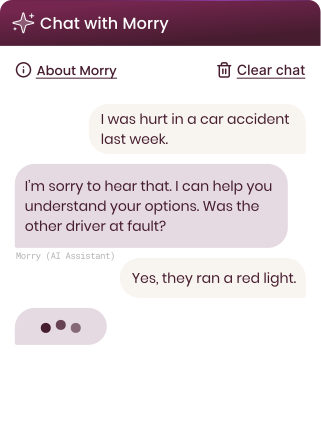
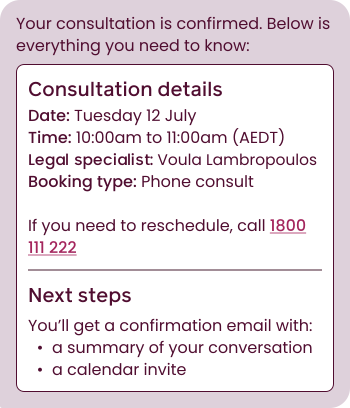
We work with you to secure proper and adequate provision from the estate. Start by chatting with Morry about your circumstances. If you have a claim, our team will guide you through the next steps.
Your first consultation is obligation-free. After that, we work with you on a No Win, No Fee basis.
01
You'll meet with one of our lawyers to talk through your options. We'll assess your claim and advise you if it is strong enough to proceed with.
02
We’ll explain how we think we can run your case to get the best possible outcome with minimal stress.
03
We settle most will disputes quickly and discreetly out of court. If a negotiated settlement is not possible, we'll work with you to prepare the matter for trial.
Not sure if you can contest a Will? Chat with Morry to discuss your situation and explore your options in minutes.
A Will is a legal document that enables you to determine how your estate is to be distributed after your death. This includes your money, property, shares, investments and possessions. Having a valid Will means you decide how you want your assets to be distributed instead of leaving it to chance.
A simple Will will generally apply to you if:
you do not have ‘complex’ family situations such as step-children or a blended family
you or your partner do not run a business, have a self–managed super fund or a family trust.
A complex Will will generally apply to you if:
you or your partner have children (including adult children) from a previous relationship
you or your partner operate a business, have a family trust or a self-managed super fund
your beneficiaries have special needs (such as a disability or an inability to manage money) and you would like to discuss ways to protect them.
The laws governing the legal requirements for preparing a valid legal Will in Australia vary from state to state; however, in all states, for a Will to be valid, there are some basic requirements:
you must have testamentary capacity, which means that you must be over 18 years old and understand what you are doing
your Will must be in writing (whether handwritten, typed or printed)
your Will must be signed, and two witnesses (over the age of 18) need to witness your signature
those witnesses must also sign the Will.
The most important part of contesting a Will is to get started early. It can take time to organise what you need to make your claim and you don’t want to miss any of the strict time limits that apply. Generally, you have between six and 12 months (depending on which state you're in) following the date of death, or the date probate was granted, to lodge your claim. In some jurisdictions, the time limit commences when probate is granted.
There is a difference between challenging a Will and contesting a Will, however the terms are often used interchangeably.
Challenging a Will is generally used when you challenge the overall validity of a Will and contesting a Will is generally used when you are contesting the provisions contained in the Will.
For our Will dispute clients, we offer a No Win, No Fee arrangement. This means you only pay our legal fees if we are successful, and these fees will generally be paid out of the Estate.
It’s important to understand that the estate of the deceased needs to be substantial enough to warrant disputing the Will. If we don’t believe the estate is substantial enough for you to dispute, we will be upfront with you and let you know in your first obligation-free consultation.
The costs to contest a Will are generally deducted from the settlement amount paid out by the estate. Our fees vary depending on the circumstances of each Will dispute, so it’s best to speak with one of our expert Will dispute lawyers to find out about the likely fees for your situation.
We settle 98% of Will disputes quickly and discreetly out of court.
If a negotiated settlement is not possible, we’ll work with you to prepare the matter for trial.
If your case does need to go to court, one of our experienced Will disputes lawyers will represent you and do the negotiating. We understand how stressful and emotional this process can be, so we do everything we can to make it easier for you.
The court will decide what is adequate provision for your ‘proper maintenance, education and advancement in life’ from the deceased person’s estate, considering all the circumstances of the case.
For some eligible people, the Court will also need to be satisfied that there are factors warranting the making of the application.
While contesting a Will is generally used when you are contesting the provisions contained in the Will, challenging a Will is when you challenge the overall validity of a Will.
You may be able to challenge the validity of a Will if:
you believe the deceased didn't have capacity to make a Will, or
they were under undue influence.
It’s important to understand the time limitations for these types of claims.
This claim must be made before probate is granted. If probate has already been granted, this means that the Court has legally recognised the validity of the Will and the executor responsible for the distribution of the estate and assets. If your claim is made late, there might end up being no estate to claim against if the executor finishes distributing the estate first.
When someone dies without a Will, this is known as ‘dying intestate’. With only around 50% of people having a Will, it is more common than you might expect. However, while it’s not uncommon, a loved one dying intestate can make matters more complicated.
If your loved one has passed without a Will, an application needs to be made to the Court to appoint a person to act as the Administrator of the estate. This is because there is no executor appointed to manage the affairs.
This application is referred to as an application for a Grant of Letters of Administration on intestacy and it’s the first thing you need to do. The process can be complex and it’s best to have a lawyer assist you in making the application.
In all cases where it is necessary to apply for a Grant of Letters of Administration, it is usually the person with the greatest entitlement to the estate, as determined by applying the intestacy formula, that applies for the Grant. For example, if a spouse or partner survives the deceased, they would usually bring the application. If the deceased is survived by children (and no spouse/partner) then one or more of them could apply.
Read more about Wills.
We have lawyers who specialise in a range of legal claims who travel to Australian Capital Territory. If you need a lawyer in Canberra or elsewhere in Australian Capital Territory, please call us on 1800 675 346.
We have lawyers who specialise in a range of legal claims who travel to Tasmania. If you need a lawyer in Hobart, Launceston or elsewhere in Tasmania, please call us on 1800 675 346.
/farm-inheritance-disputes-succession-planning-thumbnail.jpg)
/searching-for-a-will-australia-thumbnail.jpg)
/MB_Wills-And-Estates_Probate_300x300px_WEB.jpg)
/does-marriage-revoke-a-will-in-australia-thumbnail.jpg)