
 Global search
Contesting a Will means asking the court to review the proposed distribution of assets in a deceased person’s will.
This may be appropriate if the Will doesn’t reflect the deceased’s wishes or doesn’t provide adequate financial support for people who relied on them.
In Queensland, succession law recognises that certain people may be entitled to be properly provided for from an estate. If that hasn’t happened, you may be able to make a claim for a fairer outcome.
The following people may be eligible to contest a Will in Queensland:
In Queensland, a dependant can be a parent of the deceased or a parent of the deceased’s minor child who was wholly or substantially maintained or supported by the deceased at the time of death.
Yes. stepchildren may be eligible to contest a Will. This includes children of a de facto partner, provided certain legal criteria are met.
There is an important distinction between challenging a Will and contesting a Will, although the terms are often used interchangeably.
Challenging a Will refers to disputing its overall validity, for example, arguing that it is not legally valid.
Contesting a Will, on the other hand, generally involves disputing the provisions within it, such as whether the distribution of the estate is fair or appropriate.
There are several reasons a Will may be challenged, including:
This occurs when the person making the Will was pressured, manipulated, or coerced into changing their wishes, often while they were vulnerable.
This applies where the Will or signature is not genuine, such as where a document has been altered or signed without the deceased’s authority.
Improper execution means the legal requirements for making a Will were not followed, for example, if it was not properly signed or witnessed.
This arises when the person was not of sound mind at the time the Will was made and may not have fully understood what they owned or who should benefit.
These are broader concerns about whether the Will is legally valid.
 Any questions? Check out our FAQs.
Any person with a legal interest in a deceased’s estate can challenge a Will. This may include:
Contesting a Will can feel overwhelming, but understanding the process can help.
In most cases, you have six months from the date of death to make a claim. If a Will isn’t contested within this time, the estate may be distributed.
Generally, all legal proceedings must be commenced within 9 months of the date of death. Claims outside this period are sometimes accepted, but only in limited circumstances.
If possible, request a copy of the Will and any previous Wills from the executor or the lawyer who drafted the Will. This will help establish which legal remedies you are eligible to pursue.
This might include financial records, medical reports, or proof of your relationship and dependence.
We understand that contesting a Will can be stressful, especially during an already difficult time. Our experienced Gold Coast team will support you with clear advice and practical guidance, focused on achieving a fair outcome.
Every claim is different, and the laws surrounding Will disputes are complex and vary from state to state.
Contact our Southport or Palm Beach offices to speak with an experienced lawyer who can guide you through your next steps. Your first consultation is obligation-free.
In Queensland, you generally have 6 months from the date of death to start a claim. There are limited exceptions, but acting early is important to protect your position.
If you’re an eligible person, such as a beneficiary, spouse, child or dependant, you can request a copy of the Will from the executor or through the court once probate is granted. This is often the first step in understanding whether you may have a claim.
Yes. Beneficiaries are entitled to see the Will and must be provided a copy. Eligible people excluded from a Will can also request a copy to assess their rights.
Legal costs are often paid from the estate, particularly where a claim is reasonable. However, this can vary depending on the strength of the case and the outcome, so it’s important to get advice early.
If your claim is successful, the court may adjust how the estate is distributed so that fair provision is made. In most cases, parties will voluntarily agree to a fairer distribution of the estate.
Evidence will depend on your circumstances but may include financial records, details of your relationship with the deceased, medical reports, and witness statements. Strong evidence can make a meaningful difference to the outcome of your claim.
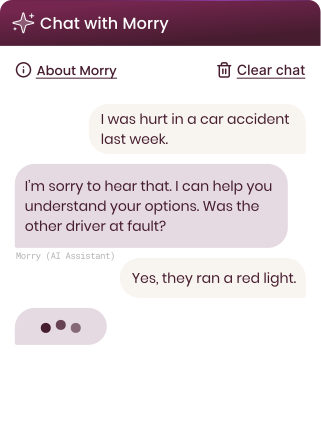
Not sure if you can contest a Will? Chat with Morry to discuss your situation and explore your options in minutes.
Read more about Wills.
We have lawyers who specialise in a range of legal claims who travel to Australian Capital Territory. If you need a lawyer in Canberra or elsewhere in Australian Capital Territory, please call us on 1800 675 346.
We have lawyers who specialise in a range of legal claims who travel to Tasmania. If you need a lawyer in Hobart, Launceston or elsewhere in Tasmania, please call us on 1800 675 346.



/farm-inheritance-disputes-succession-planning-thumbnail.jpg)
/searching-for-a-will-australia-thumbnail.jpg)
/MB_Wills-And-Estates_Probate_300x300px_WEB.jpg)
/does-marriage-revoke-a-will-in-australia-thumbnail.jpg)