
 Global search
Family provision claims exist in every Australian state and territory, though the rules differ depending on where the deceased person lived at the date of their death or where the majority of the deceased’s assets were held.
The core idea behind this type of claim is that certain people should receive adequate provision for their proper maintenance and support, even if their loved one’s Will says otherwise.
Not everyone is entitled to challenge a Will. Laws in each state define who is considered an “eligible person.” These can include:
Every situation is different. The court will look at the details of your case, especially your relationship with the person who died and your financial need.
Your current and future financial position is a central factor. The court also weighs the quality and duration of your relationship with the deceased. A long-term, supportive relationship carries significant weight.
Factors such as your ability to earn, age, disability, and current living arrangements all contribute to building a picture of what constitutes “adequate, proper provision”.
If others have a stronger claim, such as minor children, a dependent spouse, or someone with a disability, your potential share may be affected. Courts aim to divide the estate across all eligible parties based on the testamentary wishes of the deceased and, the competing needs and circumstances of the beneficiaries and family provision claimants, not necessarily equally.
 Any questions? Check out our FAQs.
There’s more to a claim than filling out a form. If you’re looking to contest a Will, understanding your entitlements and obligations from the outset will help avoid costly errors.
Be ready to provide:
This information supports your claim and helps your legal team build a compelling case.
Many claims resolve through negotiation or mediation. This saves time, stress, and legal costs. An early, fair settlement can provide closure and preserve family relationships. However, if negotiations fail, the court remains an option.
If you’re an executor or named beneficiary, a family provision claim can feel like a challenge to the deceased’s final wishes. Still, the law allows some people to seek further provision, and that claim must be managed properly.
The role of an executor is to act in the best interests of the estate. This includes disclosing relevant information, preserving assets and not distributing assets until the claim is resolved.
Failing to do so can expose the executor to personal liability.
If the claim lacks merit, you’re not without options. A well-prepared response can reduce or defeat a claim. Evidence of the deceased’s intentions, previous financial support provided to the claimant, and the impact on other beneficiaries can all help defend the estate’s position.
In some cases, the estate pays legal fees. In others, each party covers their own. Courts may order costs against a party who acted unreasonably or pursued a weak claim. Clear advice early helps manage these risks.
Disputes over Wills can strain relationships. A claim may uncover long-buried tensions or expose family dynamics. That’s why it’s crucial to work with a legal team that not only understands the law but also understands people.
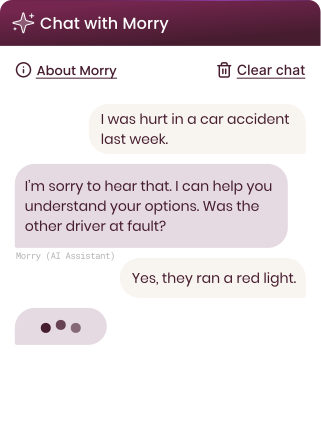
Not sure if you can contest a Will? Chat with Morry to discuss your situation and explore your options in minutes.
Dying without a Will, known as dying intestate, doesn’t automatically prevent a family provision claim. If the statutory-legal distribution of assets doesn’t recognise your relationship or dependency on the deceased person, you may still be eligible to challenge that distribution. This is especially important in cases involving de facto partners, stepchildren, or other close relationships not covered by intestacy laws.
Yes, both can be eligible. However, you’ll need to prove the nature of the relationship. In Queensland, NSW, for instance, stepchildren can bring a claim if they were dependent on the deceased and a member of the same household. In Victoria, de facto partners must show they were living with the deceased person in a genuine domestic relationship for at least two years or resulted in the birth of a child who is a minor at the date of death.
Each case is unique. The strength of the relationship, financial interdependence, and level of support received are all considered.
Being financially reliant strengthens your position. Courts take dependency seriously, especially when someone contributed to the household, cared for the deceased, or relied on them for essential support. That dependency might have been formal (for example, under a carer’s agreement) or informal, such as living under the same roof and receiving daily support.
Deadlines for family provision claims are strict. Extensions may be granted, and courts require compelling reasons before they will consider a late application.
Late applications can still proceed, but only with court approval. You'll need to show a valid reason for the delay. The longer the delay, the harder it becomes to succeed. Seeking advice early gives you the best chance to protect your rights.
Verbal promises can carry weight, especially if supported by witnesses or actions that back them up. While Wills are written documents, courts do consider the broader picture, especially where there’s evidence of reliance on a promise.
Yes. If you believe the Will was invalid due to undue influence, fraud or lack of capacity, you may contest it. Separately, if you were left out or inadequately provided for, you may bring a family provision claim. These are distinct processes but can run in parallel.
The first step is to get legal advice as quickly as possible. Your lawyer will help you gather evidence of your relationship with the deceased, your financial circumstances, and any contributions you made to the estate.
Most claims begin with a formal letter to the executor and move to negotiation or mediation before any court involvement. Maurice Blackburn can guide you through each step, from initial advice through to resolution.
Read more about Wills.
We have lawyers who specialise in a range of legal claims who travel to Australian Capital Territory. If you need a lawyer in Canberra or elsewhere in Australian Capital Territory, please call us on 1800 675 346.
We have lawyers who specialise in a range of legal claims who travel to Tasmania. If you need a lawyer in Hobart, Launceston or elsewhere in Tasmania, please call us on 1800 675 346.



/farm-inheritance-disputes-succession-planning-thumbnail.jpg)
/searching-for-a-will-australia-thumbnail.jpg)
/MB_Wills-And-Estates_Probate_300x300px_WEB.jpg)
/does-marriage-revoke-a-will-in-australia-thumbnail.jpg)